First Timers at the Farmers' Market

The next time I take a friend to the farmers' market for the first time I'm going to ask her to give me her money before she gets out of the car. "It's for your own good," I will explain.

First timers to the farmers' market are an easy spot. They're the ones walking around with hibiscus plants and iris bulbs. They buy dark chocolate covered almonds, marmalade made from fruit that is as difficult to spell as it is to pronounce. They buy the handmade dishes from the woman with artisan honey, a lavender sack to rest upon their eyes. And they need the soothing fragrance once they realize they've spent their grocery money on a flower that won't grow in the fog, a jelly too pricey to eat on ordinary toast and a dish that is crooked. (Note: I love dark chocolate covered almonds and crooked dishes.)

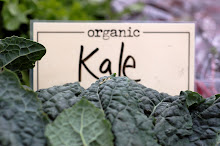
First timers don't see the bunches of kale, rainbows of peppers, potatoes, apples or eggs the color of dirt. They are blind to cucumbers, carrots and cabbage. Who cares about cilantro, cauliflower and corn. What, there's watermelon? Radishes? Broccoli? Get out of my way, they seem to yell rushing past the produce and zeroing in on Swedish waffles, crepes with bananas. They jostle for position in the line for kettle corn, indian food, cheese bread, cinnamon rolls. They stock up on tamales and olive tapenade; taste cheese priced in double digits and buy candles made of beeswax.

The cute guy went to the farmers' market once to do our weekly shopping. I kid you not, he came home with granola, sausages and lettuce. That was it. "It was too overwhelming," he said. He's right. It is.

That's why I will take my first-time-to-the-market friend's money. I don't want them getting home with an empty wallet, nothing to eat and a bad taste. It takes practice to see the real food through the fair like atmosphere. To put on a grocery shopping hat when nothing about the farmers' market resembles what most of us are used to. Except the impulse buys to lure us away from buying plain old real food. Those exist everywhere.

If you're in the market for impulse buys, the farmers' market is the best. Just don't take your grocery money.

And if you're at the farmers' market for groceries, keep your hat on and buy real food first. Then decide if you need a jar of the calamondin marmalde. (It is delicious.)

Haiku Friday


Picked from the road side
four foot fennel fills a vase
beautifully.

Consider The Farmer

Since I began eating seasonally I keep a piece of fruit on my desk in a nearly flat celadon green bowl. A bowl the size of my palm with a single painted stem of bamboo. It's the perfect pedestal for a late summer peach, a newly shined apple, one blood orange, three figs or a winter persimmon. The fruit is elevated to art, displayed as if it were still a flower on the branch.

I study the fruit as if I were going to draw it, paint it, as if someone else already committed it to canvas. I notice the places the colors fade, stretch, pull forward, the texture, stem. The places where the juice is held in its miraculous skin.

I consider the farmer that planted the tree. That waited moons and storms for the tree to produce, worried over it, watered and watched it as close I do at my desk. I consider the field worker who picked the fruit, boxed it, put it on the truck for market. And I consider the person I handed my cash to. A simple exchange of smiles, a balancing act of bags in a weathered market with a tent.

It's not until I've lifted the fruit from it's perch, one bite removed, that I reach back for the landscape from which it came. The apples that were barely formed during the California fires. Is there a flavor of the haze that hung over us for days and weeks? And the peaches, they taste like more sunny days then I remember the summer containing. How is that possible? The first fall figs are nearly bland, rushed somehow, hesitant to invest their sugar. What do they know that I don't? I suppose I'll have to watch and see.

It's a small pleasure this one of contemplating the fruit. But it feeds me well.

Farm-Free Salmon Pledge

The Muse has done it again. Remember our dinner many weeks ago when she declared farmed salmon for her dinner with a determined hurrah fling of the menu. And then I spilled stories of farmed salmon I'd been reading and she ordered a lovely pasta dish. Well, the Muse has taken no-farmed-salmon another couple of steps.

First, not long after our meal she was at the same restaurant with a friend and before the menus were opened said, "You can't order the salmon!" No further discussion was necessary and I'm still laughing at the story.

Now the Muse has found the Farm-Free Salmon Pledge at Fish restaurant in Sausalito. The pledge encourages restaurants and retailers to remove farmed salmon from their menus and shelves. Individuals can take the pledge too and remove it from their carts and tables.

Fish has printed the Pledge on recycled 5x7 card stock for customers to take and/or distribute. The Muse took the Pledge herself and is taking the card to the restaurant of our not quite legendary no-farmed-salmon dinner. And she gave me several to distribute too.

It's exciting or maybe I'm naive. But I believe if people learn about the impact the farming has on the environment and the facts that farmed salmon is fake and dyed and bolstered up with antibiotics they wouldn't want to support farmed salmon. Let alone eat it.

If you know a restaurant(s) or retailer(s) you would like to have receive the Farm-Free Salmon Pledge card, or you would like some yourself, email me from the sidebar with the business name and address or yours and I'll happily put the Pledge card or cards in the mail.

Let's get busy. There's still a lot of hope to restore the runs of the wild salmon. Delicious wild salmon, I might add.

The Farm-Free Salmon Pledge.

In the spring of 2008, the Pacific Fishery Management Council announced the closure of both the commercial and sport fishing for wild Chinook and Coho Salmon for California and Oregon coasts and rivers. The immediate impact of this will cost the west coast over 200 million dollars and over 4,200 jobs. The long term effects could be much greater if we don’t act now.

Fish. restaurant in Sausalito, Ca. is taking the first step by introducing the Farm-Free Salmon pledge. Restaurants and retailers taking this pledge will remove farmed salmon from their menus and shelves using only wild salmon when it is available. By doing this, they will protect the marine food webs that are plundered to support farmed salmon, prevent the waste that open ocean pens produce, and eliminate the possibility of escape of non-native species into our west coast ecosystems while supporting the fishing communities that depend on healthy oceans and wild salmon populations for their future.

Today, rivers and streams on the Pacific Coast are dammed, degraded, drained, diverted, buried under silt or otherwise unable to support abundant salmon populations. Consequently, some salmon populations that once supported communities along our Pacific coast are severely imperiled to the point where numerous fish populations are now protected by the federal and/or state Endangered Species Acts.

The loss of Pacific salmon populations has damaged coastal and tribal communities all along our coast and inland to Idaho and Nevada. Across the country, families are faced with the choice of paying high prices for wild salmon (if they can be found), or buying farmed Atlantic salmon of dubious quality and nutritional value, or not eating salmon at all. Commercial fishermen have been forced to fish in unsafe weather in order to make boat, insurance, and related payments. Over the last couple of decades, the Pacific Coast commercial fishing fleet has declined from more than 10,000 salmon fishermen to 1,000.

Many of these remaining fishing men and women work second jobs in to order to make ends meet. Native American tribes can no longer depend on the salmon for sustenance as they always have; as a result, these people are suffering skyrocketing increases in heart disease and diabetes. As salmon populations decline, more and more of their food now comes from the grocery store – it is high in starch, fats and sugars.

But salmon are very resilient! If you restore healthy rivers and habitat and give them a half a chance, they will bounce back. Case in point: Sacramento River winter run Chinook salmon nearly went extinct in the early 1990’s; their numbers had dwindled to a mere 186 spawning adults.

Once they were protected under the Endangered Species Act, measures were undertaken to restore habitats in the Sacramento River. Dams were modified to provide cooler water for incubating salmon eggs. A nearby mine that was leaking acid into the Sacramento River was cleaned up. Another dam that was blocking salmon migration was opened. Within a few years of these improvements, winter run Chinook salmon numbers had increased to over 8,000 spawning adults.

The winter run of Sacramento River Chinook salmon is still imperiled; we can restore these populations if we choose to protect and enhance their freshwater habitats.

Creating A World That Can Feed Itself

I received an email from Michael Pollan this afternoon. That was no surprise (subscribe here) but the content dropped my jaw. MP was on a panel this week with Hugh Grant, the CEO of Monsanto, the discussion of which is available on Youtube.

I delayed what I should have been doing and watched. I was ready for a showdown. And I was ready for Monsanto to say, no, everything that is being said about GMO's is wrong and here's why it's all wrong. That would have been good.

The panel is pitifully short at 36 minutes though. Michael Pollan does a great job of presenting facts. And Hugh Grant is likable. He makes the audience laugh and with his sleeves rolled up talks about how we all have to work together.

None of the big issues of world hunger, the future of seeds or the green revolution in Africa were solved, they were barely addressed in the minutes available but I have my fingers crossed that we can see more public discussions with Monsanto.

I need to know more. We all do.

I'd love to know your thoughts if you have the time to watch.

Haiku Friday


Minutes 'til midnight
the damp smell of fall sifts through
the open window.

Green Backlash

I'm having dinner with the Muse tomorrow night. And I know she'll ask me, "What is one green thing you've done recently?"

I'll have to stop and think. I mean, I've gotten in a rut recently with my one green things. I've begun to justify the actions I take that aren't green as a result of the green habits I do take on. Let me be cliche', one step forward and two steps back. The pendulum of change keeps knocking me in the ass and pushing me in the wrong direction.

Diet coke has tempted its way back into my occasional drink of choice. "Medicinal," I explain to the heavens if no one else is around. Out of the corner of my eye I see the village in India though, with its water supply depleted by Coke. I rehearse the numbers; calories to make, can and distribute the soda compared to the energy calories in the soda. The numbers don't lie - I'm going to hell.

And yes, okay, since I'm already doomed, I'll admit it. I'm back on Starbucks too. Jeez. Is nothing sacred? Double tall lattes'. Put me in jail. They are delicious. I know. I met the tall Guatemalan God who advocates fair trade coffee beans without a middleman. He looked me square in the eye. And I've read about the bean farmers who can't get a fair price for their crops while our corporations grow richer. But, what can I say? Okay, I'll find fair trade coffee in the neighborhood if I'm going to continue to drink coffee. ButinthemeantimeI'mhavinglattes.

See what I mean. I've become petulant. Maybe it's the caffeine.

How are you doing with taking action on a green thing or two? Let me know. I need some momentum to move this backlash in the other direction. Hopefully before tomorrow night.