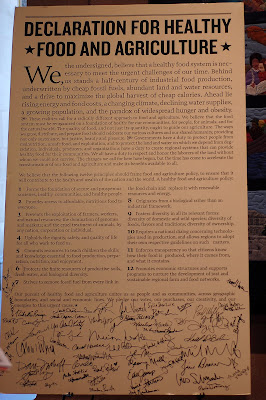
 Endorse this.
We, the undersigned, believe that a healthy food system is necessary to meet the urgent challenges of our time. Behind us stands a half-century of industrial food production, underwritten by cheap fossil fuels, abundant land and water resources, and a drive to maximize the global harvest of cheap calories. Ahead lie rising energy and food costs, a changing climate, declining water supplies, a growing population, and the paradox of widespread hunger and obesity.
These realities call for a radically different approach to food and agriculture. We believe that the food system must be reorganized on a foundation of health: for our communities, for people, for animals, and for the natural world. The quality of food, and not just its quantity, ought to guide our agriculture. The ways we grow, distribute, and prepare food should celebrate our various cultures and our shared humanity, providing not only sustenance, but justice, beauty and pleasure.
Governments have a duty to protect people from malnutrition, unsafe food, and exploitation, and to protect the land and water on which we depend from degradation. Individuals, producers, and organizations have a duty to create regional systems that can provide healthy food for their communities. We all have a duty to respect and honor the laborers of the land without whom we could not survive. The changes we call for here have begun, but the time has come to accelerate the transformation of our food and agriculture and make its benefits available to all.
We believe that the following twelve principles should frame food and agriculture policy, to ensure that it will contribute to the health and wealth of the nation and the world. A healthy food and agriculture policy:
Forms the foundation of secure and prosperous societies, healthy communities, and healthy people.
Provides access to affordable, nutritious food to everyone.
Prevents the exploitation of farmers, workers, and natural resources; the domination of genomes and markets; and the cruel treatment of animals, by any nation, corporation or individual.
Upholds the dignity, safety, and quality of life for all who work to feed us.
Commits resources to teach children the skills and knowledge essential to food production, preparation, nutrition, and enjoyment.
Protects the finite resources of productive soils, fresh water, and biological diversity.
Strives to remove fossil fuel from every link in the food chain and replace it with renewable resources and energy.
Originates from a biological rather than an industrial framework.
Fosters diversity in all its relevant forms: diversity of domestic and wild species; diversity of foods, flavors and traditions; diversity of ownership.
Requires a national dialog concerning technologies used in production, and allows regions to adopt their own respective guidelines on such matters.
Enforces transparency so that citizens know how their food is produced, where it comes from, and what it contains.
Promotes economic structures and supports programs to nurture the development of just and sustainable regional farm and food networks.
Our pursuit of healthy food and agriculture unites us as people and as communities, across geographic boundaries, and social and economic lines. We pledge our votes, our purchases, our creativity, and our energies to this urgent cause.
Please endorse this. You will be in good company and your participation matters.
Thank you.
 I love the city. I really do. But when I take a few days off I want to hit the country. Which is how the cute guy and I spent a long weekend. We headed north. To apple country.
 .jpg) I remembered her pulling on to the side of the road, two wheels in the field. It was before there were fences, orchards as far as Christmas. "Come on," she'd say. "Let's get apples." And I'd pick as many from the ground as I could carry. "They're Gravensteins," she'd sing, which meant nothing to me except Gravensteins made her happy.
I remembered her pulling on to the side of the road, two wheels in the field. It was before there were fences, orchards as far as Christmas. "Come on," she'd say. "Let's get apples." And I'd pick as many from the ground as I could carry. "They're Gravensteins," she'd sing, which meant nothing to me except Gravensteins made her happy. .jpg) The article explained that the apple growers aren't picking the fallen apples traditionally used for juice. There's no where to take them. The US apple juice market is sustained by China. It's cheaper.
The article explained that the apple growers aren't picking the fallen apples traditionally used for juice. There's no where to take them. The US apple juice market is sustained by China. It's cheaper.  I read the names of the apples; Northern Spy, Sierra Beauty. There were more varieties than there are holidays. I could see them in the field, on the trees and the ground. I could happily smell them but couldn't help wondering, will the apple fields be there the next time? Or will we need to go to China to buy them off the farm?